
Remove the tyre from the measurement
On a traditional roller dyno, the tyre is part of the measurement system.
Tyre temperature, pressure, deformation and available traction can all change between runs. As power increases, tyre slip can become the limiting factor long before the engine or turbocharger has reached its limit.
Strapping also affects the result. Increasing strap tension pushes the tyres harder into the rollers, increasing deformation and losses. A car can therefore show less wheel horsepower simply because it was strapped differently.
This can become misleading during tuning. You add 0.2 bar of boost and see only 10 HP more, while the same change previously produced 50 HP. It is easy to conclude that the compressor is out of its efficient range when the real problem may simply be that the tyres no longer have enough traction to transfer the additional power to the rollers.
Change the car, not the measurement system
Repeatability matters when comparing modifications over weeks or months. Imagine measuring a car, then returning later with a larger turbo. In the meantime the lightweight 16-inch wheels have been replaced by large, heavy 20-inch wheels for better road traction, and the vehicle is strapped to the roller dyno slightly differently.
The engine may genuinely be producing more power, yet the measured wheel horsepower can remain almost unchanged because the larger wheels, tyres and different strapping introduce additional losses.
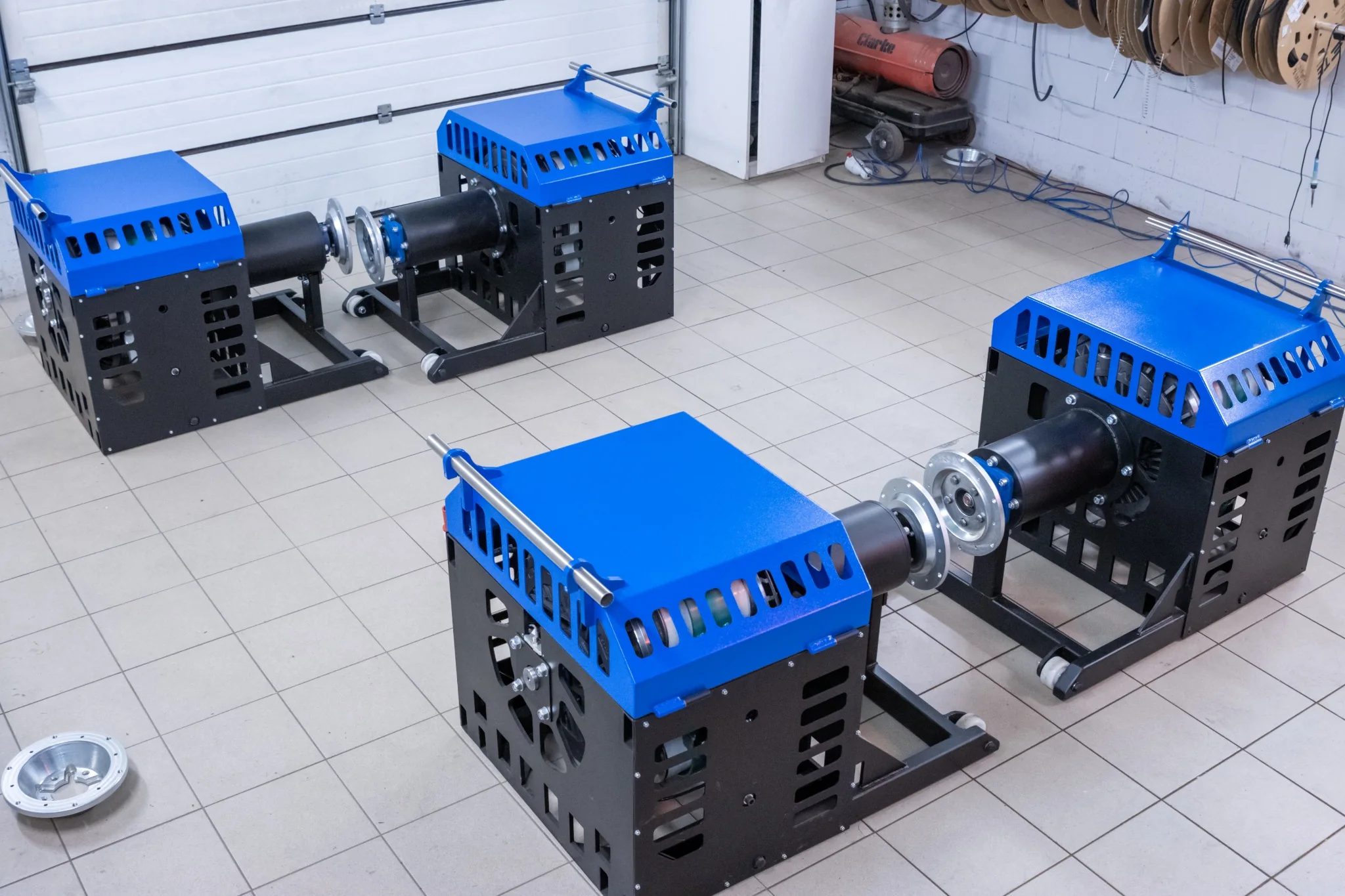
A hub dyno removes those variables. The wheels are removed and the dyno connects directly to the hubs. There is no tyre slip, tyre deformation or wheel inertia to change between tests. That makes before-and-after comparisons much easier to trust.
Variables removed by direct hub connection
- Tyre slip on the rollers
- Tyre temperature and pressure variation
- Tyre deformation under load
- Different wheel and tyre inertia
- Changes in strapping tension
Simple vehicle setup
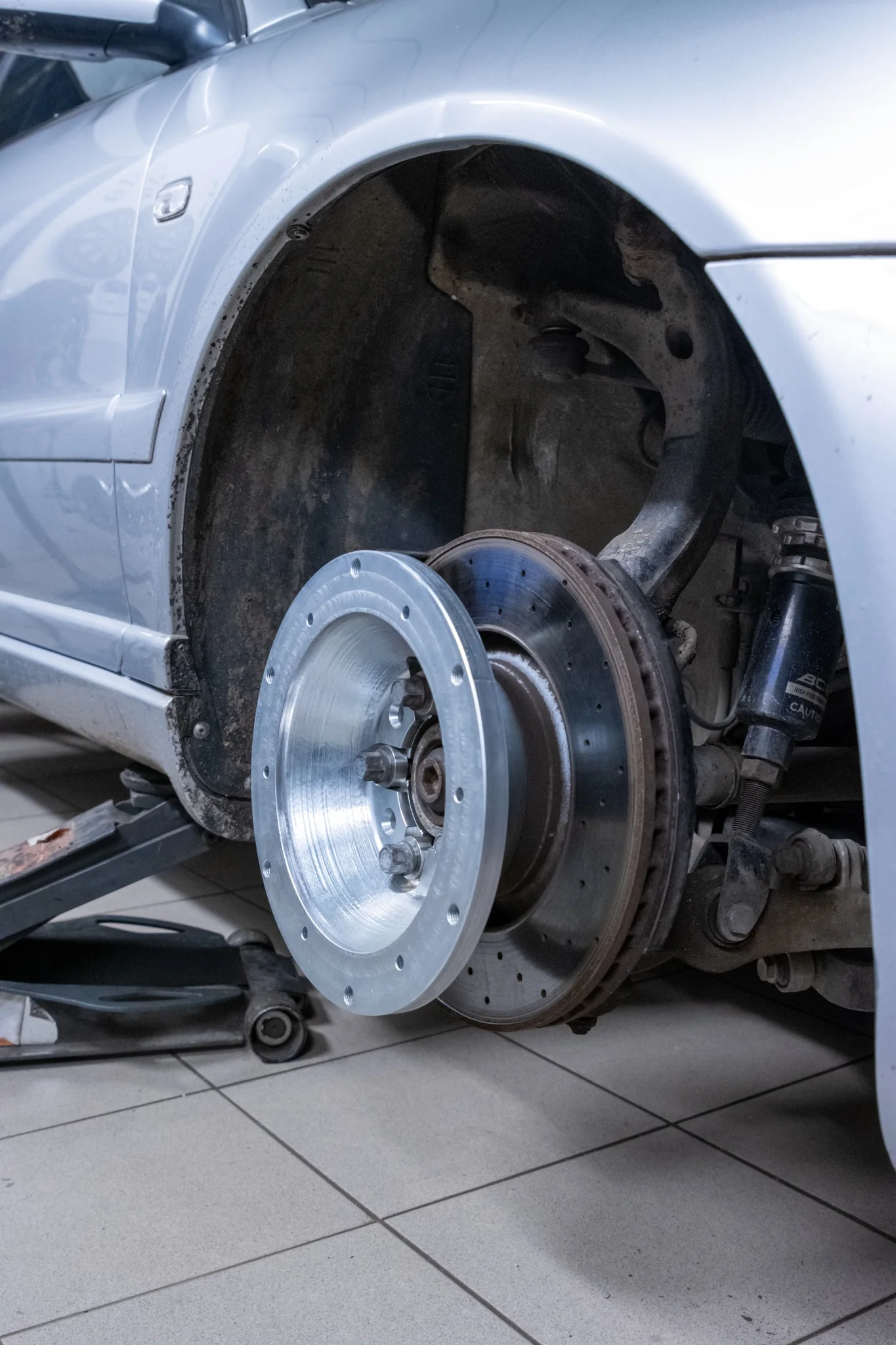
Jack the car, remove the wheels, install and torque the adapters, then connect the dyno units.
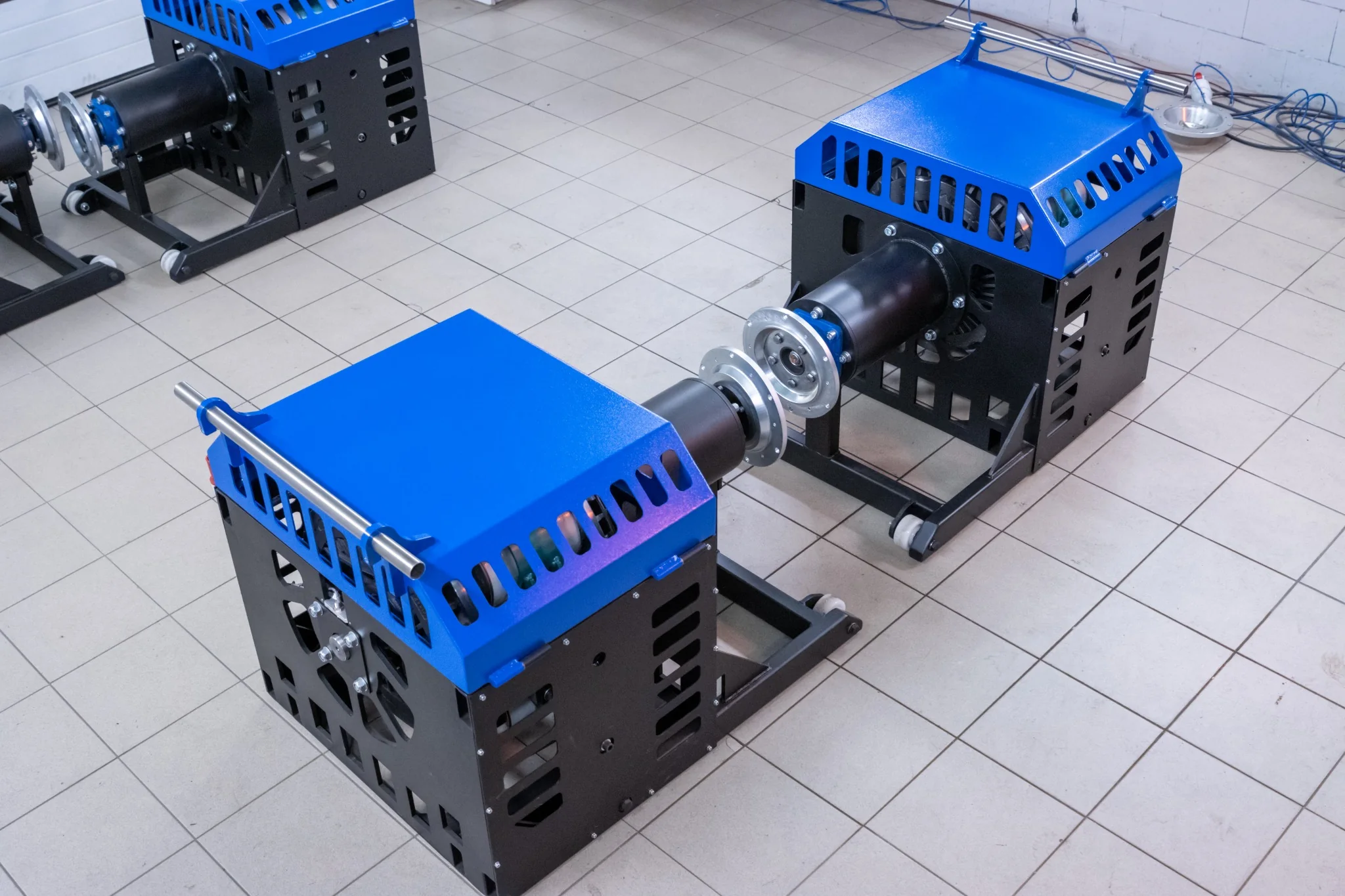
Kamuto Productions dynos use an articulated adapter connection and what we call a long nose. The articulation means the dyno does not need to be positioned with millimetre precision before connection — the coupling can be adjusted to meet the vehicle without repeatedly moving the complete dyno unit.
The long nose keeps the main dyno frame away from the bodywork and provides useful working space around the hub. There is room for an impact gun instead of being forced to work with a hand wrench, and the frame stays clear of body kits, low rear quarters and narrow drag-car rear bodywork.
Four main parts of a hub dynamometer
Retarder
Creates the controlled braking load that the engine and drivetrain must overcome.
RPM sensor
Measures hub speed and acceleration so the controller knows how quickly each connected hub is accelerating.
Load cell
Measures retarder reaction force. With calibrated torque-arm geometry, this gives torque at the dyno hub.
Control system
Sportdevices SP6 controls retarder load according to the selected ramp or steady-state test and records the measured data.
During a controlled ramp run, the RPM measurement tells the control system how quickly the hubs are accelerating. The controller continuously adjusts retarder load to maintain the requested acceleration rate. At the same time, the load cells measure torque at the hubs. Engine RPM and measured hub data are then used to display the dyno graph and calculate power.
Important: the dyno directly measures torque at the hubs. Crankshaft torque or power requires an additional drivetrain-loss model or calculation and should not be confused with the directly measured hub result.
Why does a hub dyno need thousands of Nm?
Engine torque is not the same as torque at the driven hubs. Gearbox and final-drive ratios multiply or reduce torque before it reaches the dyno. This is why a naturally aspirated engine producing only 700 Nm at the crank can still require a dyno with several thousand Nm of axle braking capacity.
For example, with 700 Nm engine torque, an effective 1.25:1 transmission ratio and a 4.0:1 final drive, theoretical driven-axle torque before drivetrain losses is approximately:
That is already a substantial axle load from a naturally aspirated engine. Add forced induction, a shorter gear, or a shorter final drive and required retarder capacity rises quickly.
Why Kamuto Productions starts at 5200 Nm per axle
We consider strong braking reserve essential for professional tuning work. That is why our Entry single-axle system uses two 2600 Nm KLAM CFK-330 retarders for 5200 Nm total axle braking capacity and 1000+ HP capability.
The High Capacity system provides approximately 9200 Nm per axle and 2000+ HP capability. The additional capacity is not only about peak numbers — it also gives more thermal reserve for repeated testing and reduces the need to stop simply to let undersized retarders cool down.
Compare Models & PricingUniversal adapters included
Every dyno is supplied with two sets of universal adapters: one 4-bolt set and one 5-bolt set.
Additional holes can be machined for the customer's preferred vehicles when ordering. For example, 5×112 with M14 hardware is now common across many newer Audi and BMW applications.
Additional adapters can also be supplied with multiple bolt patterns. Keeping several ready-to-use adapter sets in the workshop reduces setup time when regularly switching between different vehicle platforms.
Hub Dyno FAQ
Is a hub dyno affected by tyre slip?
No. The vehicle wheels are removed and the dyno connects directly to the hubs, so tyre-to-roller traction is removed from the measurement.
Can it test FWD, RWD and AWD vehicles?
Yes. Kamuto Productions offers single-axle and AWD configurations, with single-axle control cabinets prepared for future AWD expansion.
How much power can it handle?
Our 5200 Nm single-axle system is rated for 1000+ HP and the 9200 Nm system for 2000+ HP. AWD combinations are rated up to 4000+ HP.
Why is repeatability better?
Direct hub connection removes wheel/tyre inertia, tyre temperature, pressure, deformation, slip and strapping tension as run-to-run variables.
Need help selecting the right braking capacity?
Tell us what vehicles, power levels and drivetrain layouts you normally work with.
Request a Quote